The Honest Problem Nobody Talks About
There's a moment every AI practitioner eventually encounters. The model produces an answer smooth, confident, grammatically impeccable. The client reads it and relaxes. The lawyer, the doctor, the editor, the analyst nods. The language did its work. It carried authority without carrying proof.
This is the honesty gap, and it's not what most people think it is.
The conventional take is that AI systems occasionally hallucinate that the problem is a bug to be patched, a training issue to be resolved, a matter of improving the model until it stops making things up. That framing misses the point entirely. The GenXis Research analysis The Honesty Gap: Words Vs. Math puts it plainly: the anxiety around artificial intelligence isn't merely that machines can be wrong. It's that machines can be wrong in fluent, reasonable, socially persuasive language.
That combination error plus fluency is the practitioner's nightmare. And it's why the solution isn't a better AI. It's a different relationship to language itself.
What the Honesty Gap Actually Is
The GenXis Research paper defines the honesty gap as "the distance between persuasive language and verified truth." That's a precise formulation worth sitting with. The gap isn't dishonesty in the moral sense nobody is accusing AI systems of conscious deception. The gap is structural: language that sounds true because it lacks the mathematical constraints that would force it to be true.
"Words can escape meaning," the GenXis analysis notes. "They can rationalize, soften, blur, excuse, reframe, and drift." This isn't a critique of AI specifically it's a critique of natural language as a medium. Humans have always had this problem. We call it motivated reasoning, cognitive dissonance reduction, ethical fading. The sentence "this was handled responsibly" can be true, false, or meaningless depending entirely on hidden definitions that nobody has pinned down.
AI systems didn't invent this problem. They industrialized it.
When a legal citation can be fabricated in perfect legal prose, when a medical explanation sounds clinically plausible while omitting a contraindication, when a financial summary appears authoritative while relying on stale facts the danger isn't the error. The danger is the mismatch between linguistic confidence and verified grounding. The fluency makes the error invisible.
Why Language Alone Can't Solve This
The instinct when facing the honesty gap is to reach for better language: clearer prompts, more precise instructions, additional context. The GenXis paper argues this approach is structurally insufficient. "The root problem is the squishiness of words," it states. "Language can preserve signal, but it can also metabolize error into something that sounds reasonable."
This matters for practitioners because it changes the intervention point. You cannot prompt your way out of a problem that lives in the nature of language itself. "Over time, small verbal deviations compound like a singer drifting slightly off pitch until the tonal center is lost," the analysis observes. Each approximation, each reasonable-sounding inference, each contextually appropriate hedge these accumulate. The system's output becomes increasingly disconnected from any verifiable ground truth, not because the model is broken, but because language allows that drift.
The paper defines a claim as "not merely a sentence" but a tuple containing the statement, the domain, the truth condition, and the evidence requirement. Without those four elements, language remains "expressive but under-bounded." It may point toward reality without specifying the procedure by which that reality is checked.
This definition isn't academic. It's a practitioner's diagnostic tool. When evaluating an AI output, the question isn't "does this sound right?" It's "where is the mathematical anchor?"
The Antidote: Mathematical Grounding
GenXis Research is direct about what closes the honesty gap: "The antidote is not less language, but stronger grounding: mathematical constraint, source custody, deterministic checks, calibrated abstention, and evidence memory."
Each element matters for the practitioner:
Mathematical constraint means the system operates within bounds that make certain categories of error impossible, not just unlikely. A model that must return values within a verified domain, or that cannot generate certain types of claims without external confirmation, has reduced the honesty gap structurally.
Source custody means every claim is traceable to an identified origin with known reliability. Citation-shaped language without source custody is, as the GenXis paper notes, one of the primary manifestations of the honesty gap in AI systems. "Citation-shaped language without source custody" is essentially performance it looks like knowledge but lacks the chain of verification that makes knowledge trustworthy.
Deterministic checks are verification procedures that either confirm or reject a claim with certainty, not probability. This is where AI systems lag most significantly behind human expert workflows. An expert can say "I don't know, and here's why I don't know." Calibrated abstention the system flagging when it lacks verified grounding is essential for keeping the honesty gap narrow.
Evidence memory means the system maintains the provenance of its information over time, updating when sources update, flagging when the basis for a claim has changed.
The Education Parallel: When Fluency Masks Failure
To understand why this matters in practice, consider the education sector's experience with the honesty gap a parallel that illuminates the AI practitioner's challenge precisely.
The U.S. Chamber of Commerce Foundation's Honesty Gap analysis documents how states have created misleading pictures of student achievement by lowering proficiency thresholds. The Chamber's 2026 brief, produced in partnership with the Collaborative for Student Success, explains the mechanism: "The 'Honesty Gap' measures the difference between how students perform on the national gold-standard assessment (NAEP) and how they perform on their own state's tests."
The Fordham Institute's commentary on the honesty gap details the magnitude of these disparities. In New York, over half of fourth graders were deemed proficient in math on the state test in 2024 compared to less than 40 percent on NAEP. In Michigan, 65 percent of eighth graders were proficient in reading according to the state exam, while just 24 percent cleared NAEP's benchmark. In Iowa, nearly three-fourths of eighth graders were considered proficient in math, while only a quarter met NAEP's benchmark.
The language is confident. The data is authoritative. The picture is wrong.
Dale Chu's Fordham analysis frames this as "a breach of public trust" not merely a technical flaw. The consistency of state-reported numbers versus NAEP's gold-standard assessment created systems where parents, educators, policymakers, and workforce planners made decisions based on fluency rather than fact. The problem compounded over time: "Compounding the problem is rampant grade inflation, which only got worse during the pandemic and has since widened both performance and attendance gaps."
Jim Cowen, Executive Director of the Collaborative for Student Success, told the Winston Group: "If we believe that NAEP is indeed the Nation's Report Record on student proficiency, then we would hope there is little difference between the outcomes on the two tests. But that's not the case. In many states, the gaps suggest that parents simply aren't getting the full picture of how prepared their kids are for college or the workforce."
This is what the honesty gap looks like when it metastasizes. Not a single error, but a systematic divergence between what authoritative language says and what verified data shows with real consequences for real people making real decisions.
What This Means for GenXis Research Readers
Practitioners deploying AI in any domain where stakes are non-trivial legal drafting, medical triage, financial analysis, scientific writing, educational assessment, security analysis face this structural problem. The language will arrive fluent, confident, and authoritative. The verification may not follow.
The honest answer isn't "trust but verify." It's "verify, then use language to communicate results." The sequence matters. Language that precedes verification is hypothesis, not knowledge. Language that follows verification is report, not claim.
This reframe has practical implications for AI architecture, workflow design, and deployment standards. The practitioners who close the honesty gap won't be those with the best models they'll be those with the most rigorous grounding systems.
The Practitioner's Checklist: Navigating the Honesty Gap
Based on the GenXis Research framework and the documented patterns in education accountability, here is how practitioners can systematically address the honesty gap in AI deployments:
- Require source custody on every factual claim. If the AI output contains assertions, it must include traceable origins with known reliability. Citation-shaped language without source custody is a red flag, not a feature.
- Implement deterministic verification for high-stakes outputs. Claims that will drive legal, medical, financial, or educational decisions need confirmation procedures with binary outcomes verified or not verified, not likely or probable.
- Design for calibrated abstention. When the system lacks verified grounding for a claim, it should say so explicitly rather than producing fluent non-knowledge dressed as confident assertion. The goal isn't a smooth answer; it's an accurate one.
- Maintain evidence memory. Information provenance should be tracked. When sources update or change, outputs that depended on that information should be flagged for re-verification.
- Apply domain-specific thresholds. The GenXis framework notes that a claim is a tuple including domain, truth condition, and evidence requirement. Different domains have different standards. Medical claims require different verification rigor than general information queries.
- Build friction at the right points. Smoothing out language is easy. Smoothing out verification is where the honesty gap lives. Practitioners should invest friction in the verification step, not the communication step.
Signs the Honesty Gap Is Narrowing
The education sector's experience offers a benchmark for progress. The Collaborative for Student Success analysis documents both the persistent problem and the real improvements. Massachusetts and Rhode Island closed their gaps to within five percentage points or less across both grades and subjects. Fourteen states are holding students to an equal or higher standard than NAEP in at least one grade or subject.
The trend is positive, but the work isn't finished. Iowa still shows a 45-percentage-point gap in eighth-grade math. Virginia shows a 42-percentage-point gap in fourth-grade reading. The language remains fluent. The verification gap remains wide.
Jim Cowen of the Collaborative frames the goal clearly: "To be clear, improving student outcomes takes huge commitments from states on efforts like high-quality curriculum, strong teacher development and student supports. But the truth matters."
"But the truth matters. We salute the states that are embracing the issue rather than masking it or running away from it."
That same principle applies to AI practitioners. The fluency is seductive. The truth matters.
Where the Gap Closes: A State-by-State Snapshot
The education sector's documented experience with the honesty gap provides concrete reference points for understanding how systems can narrow the distance between authoritative language and verified truth.
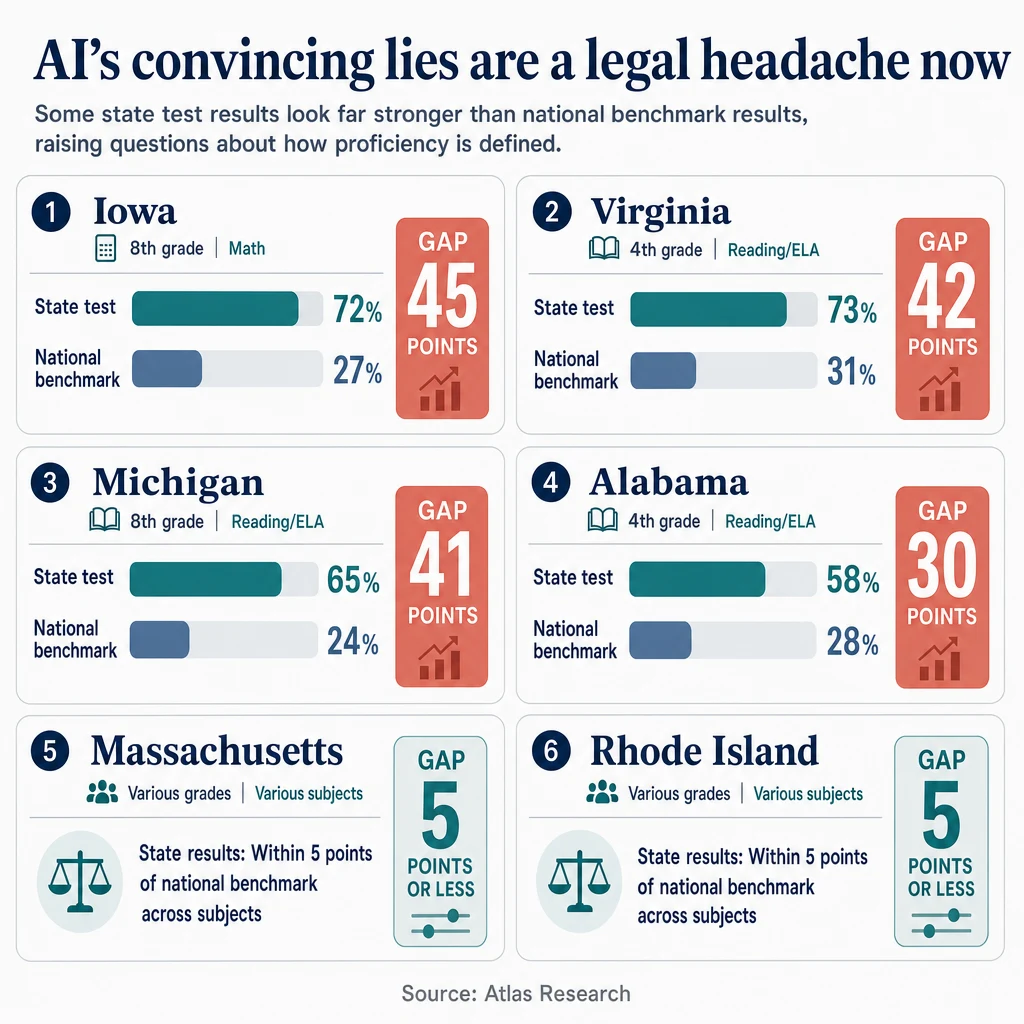
| State | Grade | Subject | State Test Proficiency | NAEP Proficiency | Gap (Percentage Points) |
|---|---|---|---|---|---|
| Iowa | 8th | Math | 72% | 27% | 45 |
| Virginia | 4th | Reading/ELA | 73% | 31% | 42 |
| Michigan | 8th | Reading/ELA | 65% | 24% | 41 |
| Alabama | 4th | Reading/ELA | 58% | 28% | 30 |
| Massachusetts | Various | Various | Within 5 points of NAEP across subjects | ≤5 | |
| Rhode Island | Various | Various | Within 5 points of NAEP across subjects | ≤5 |
Source: Collaborative for Student Success 2024-2025 analysis, as reported by the U.S. Chamber of Commerce Foundation and the Collaborative for Student Success
The states that closed their gaps didn't do so by improving the fluency of their reporting. They did so by aligning their verification standards with NAEP's gold-standard assessment. The language became less important; the mathematical baseline became everything.
The Architecture of Trust
The practitioners who build durable AI systems will be those who resist the seductive power of fluent language. The interface is for humans. The architecture is for verification. These are different requirements that sometimes conflict.
The GenXis Research analysis observes that "natural language is flexible by design. It allows approximation, metaphor, implication, emphasis, ambiguity, and context dependence." Those features make language humanly useful. They also make it a weak carrier of machine-grade certainty. The central question the paper poses "when does a sentence become a verified claim?" is the practitioner's central design question.
When the answer is "it doesn't, unless we add mathematical grounding," the architecture follows. Source custody. Deterministic checks. Calibrated abstention. Evidence memory. These aren't nice-to-haves. They're the verification infrastructure that transforms fluent language from a liability into a communication medium.
The irony is that the more fluent AI becomes, the more important these grounding systems become. Language that sounds authoritative without verification infrastructure is not a feature of sophisticated AI it's a liability that sophisticated practitioners learn to isolate, verify, and constrain.
Where to Read Further
The GenXis Research framework for understanding the honesty gap and its proposed mathematical grounding solution is developed in full in The Honesty Gap: Words Vs. Math. This is the foundational document for any practitioner working to build verification systems that keep pace with AI's linguistic capabilities.
For the education sector parallel that demonstrates how the honesty gap operates at scale and how systems have successfully narrowed it the U.S. Chamber of Commerce Foundation's Honesty Gap brief provides the policy context, state-by-state data, and business case for rigorous verification standards.
The Collaborative for Student Success maintains ongoing analysis of the education honesty gap, including their latest 2024-2025 findings documenting persistent gaps and the states making measurable progress. Jim Cowen's commentary on why "the truth matters" anchors this work in practical accountability rather than abstract principle.
For practitioners working in domains where AI-generated content will carry professional or legal weight, these sources document a pattern that AI deployments will reproduce unless verification infrastructure is built intentionally: fluency without grounding creates the conditions for systematic misleading, regardless of intent.