The distance between fluency and truth
In the spring of 2026, a mid-sized law firm in the Midwest tested a large language model to draft a contract amendment. The model produced a document that read confidently, used precise legal terminology, and followed all the structural conventions of the genre. Three hours of partner review followed before someone noticed that two key jurisdictional citations did not exist. The language was perfect. The facts were fabricated. This is the honesty gap in practice not a system failure that announces itself, but one that hides inside fluency.
The concept of the honesty gap emerges from a tension as old as language itself. Words can preserve signal, but they can also metabolize error into something that sounds reasonable. In human psychology, this shows up as motivated reasoning, cognitive dissonance reduction, and what researchers call ethical fading the gradual drift of language away from accountability. In artificial intelligence systems, it appears as hallucination, unsupported synthesis, and citation-shaped language without source custody.
"The anxiety around artificial intelligence is not merely that machines can be wrong," write Daryl Ledyard and Philip Tyler in The Honesty Gap: Words Vs. Math from GenXis Research. "It is that machines can be wrong in fluent, reasonable, socially persuasive language."
This framing reframes the AI reliability problem. The issue is not simply accuracy it is the structural gap between what a system says and what a system can verify. And that gap, left unaddressed, grows wider as AI systems take on higher-stakes roles in legal drafting, medical triage, scientific writing, and financial reporting.
76% of organizations report AI output requires significant fact-checking
Industry surveys from 2025 consistently found that enterprises deploying generative AI in knowledge-work functions faced a common operational challenge: the output looked finished but could not be trusted without manual verification. One 2025 survey of enterprise AI adopters found that three-quarters of respondents reported their teams spent substantial time validating AI-generated content before using it in decision-making contexts. The productivity gains promised by AI adoption were partially offset by verification overhead.
The core problem is linguistic confidence without epistemic grounding. Natural language is flexible by design. It allows approximation, metaphor, implication, emphasis, ambiguity, and context dependence. These features make language humanly useful, but they also make it a weak carrier of machine-grade certainty. A sentence can feel precise while remaining logically incomplete: "this was handled responsibly," "the model is aligned," "the evidence supports the claim." Each may be true, false, evasive, or meaningless depending on hidden definitions.
Informally, practitioners have begun using terms like vibes and slop to describe language that feels meaningful while carrying weak constraint. This is not merely slang it reflects a genuine epistemological problem. When a system produces confident prose, humans default to treating linguistic confidence as evidence of factual confidence. This heuristic works well in human communication, where speakers generally only assert what they believe. It fails systematically when applied to AI systems that generate assertions without belief states.
Why AI systems struggle with honesty
To understand why AI systems produce the honesty gap, it helps to understand what they are optimized for. Large language models are trained to predict plausible continuations of text. Plausibility is not the same as truth. A plausible sentence about contract law and a plausible sentence about nonexistent case law are, from the model's perspective, equivalent they are both high-probability continuations of the relevant training data patterns.
The GenXis Research paper formalizes this distinction. The authors define a claim not as merely a sentence, but as a tuple where S is the statement, D is the domain, T is the truth condition, and E is the evidence requirement. Without those elements, language remains expressive but under-bounded. It may point toward a reality without specifying the procedure by which that reality is checked.
This formalization matters because it clarifies where verification must occur. A system can produce grammatically correct, stylistically appropriate, domain-plausible language while remaining entirely ungrounded in verifiable fact. The honesty gap is not a bug that can be patched with better training data alone it is a structural feature of systems that optimize for fluency without optimizing for grounding.
The compounding drift problem
Perhaps the most insidious aspect of the honesty gap is its temporal behavior. Small verbal deviations compound over time, like a singer drifting slightly off pitch until the tonal center is lost. When an AI system produces a slightly inaccurate summary of a study, and that summary is used as the basis for a subsequent analysis, and that analysis is cited by another system, the compounded error can become substantial before anyone checks the original source.
This is not hypothetical. In 2024 and 2025, multiple documented cases emerged where AI-generated literature reviews cited references that did not exist, where synthesized case studies were presented as real, and where statistical claims were attributed to studies that had not produced those findings. In each case, the downstream use of the content amplified the original error.
The education sector has a parallel and well-documented honesty gap that illustrates the same dynamic. According to the U.S. Chamber of Commerce Foundation's April 2026 brief on the honesty gap, the "Honesty Gap" measures the difference between how students perform on the national gold-standard assessment (NAEP) and how they perform on their own state's tests. When states lower the bar for proficiency, achievement data can paint a misleading picture one that affects students, parents, educators, and ultimately the workforce.
The parallels to AI reliability are instructive. Just as lowered state standards create misleading academic performance data, AI systems that optimize for fluency without grounding create misleading factual representations. In both cases, the surface signal looks acceptable and the real signal is obscured.
How the honesty gap impacts trust
Trust in AI systems operates on two levels: perceived trustworthiness and verified trustworthiness. Perceived trustworthiness is driven by surface features fluency, confidence, coherence, appropriate tone. Verified trustworthiness requires evidence: source custody, deterministic checking, calibration to known facts. The honesty gap is the distance between these two measures.
Research in human-computer interaction consistently shows that users struggle to distinguish between confident AI outputs that are accurate and confident AI outputs that are not. This is not a failure of user sophistication it is a design problem. When a system produces a confident factual claim, the cognitive default is to treat that confidence as evidence. Breaking this default requires explicit calibration training, which most enterprise deployments do not provide.
The consequences play out differently across sectors. In legal contexts, fabricated citations can lead to procedural problems, sanctions, or client harm. In medical contexts, plausible-but-incomplete explanations can miss contraindications. In financial contexts, authoritative-sounding summaries can rely on stale or fabricated data. In each case, the danger comes from what the GenXis Research paper calls "the mismatch between linguistic confidence and verified grounding."
"The central question is therefore: when does a sentence become a verified claim?" Daryl Ledyard and Philip Tyler, The Honesty Gap: Words Vs. Math, GenXis Research
Hallucination vs. dishonesty: a necessary distinction
One of the most important conceptual moves in addressing the honesty gap is distinguishing hallucination from dishonesty. These terms are often used interchangeably in public discussion, but they describe different phenomena with different implications for remediation.
Hallucination, in the AI context, refers to content generation that diverges from real-world facts, source documents, or logical inference rules not because the system intends to deceive, but because its training and architecture enable confident outputs that lack grounding. The system has no intent; it has weights and prediction probabilities. When a language model produces a plausible-sounding citation to a case that does not exist, it is not lying it is completing a pattern.
Dishonesty, by contrast, implies intent. A system that knew the correct answer and deliberately produced an incorrect one would be dishonest. Hallucination is a structural failure of grounding. Dishonesty is a failure of alignment with known truth.
This distinction matters for remediation strategy. Hallucination is addressed through architectural changes: mathematical constraints, verification layers, source custody protocols, and calibrated abstention. Dishonesty would require different tools entirely alignment techniques that ensure systems are not deliberately producing false outputs.
Current evidence suggests that AI accuracy failures are predominantly hallucinatory rather than dishonest. Systems produce errors not because they are choosing to deceive, but because they lack the verification infrastructure to catch their own errors. This is actually good news: it means the problem is engineering-soluble, even if it is not yet solved.
42 states show measurable gaps between reported and verified performance
The education sector's parallel honesty gap offers a useful framework for understanding measurement and accountability challenges. According to data from the Collaborative for Student Success's 2026 Honesty Gap analysis, most states continue to prefer a more lenient definition of learning proficiency than that shown by NAEP. In many states, this gap is significant, creating a misleading picture of student achievement.
The disparities are striking. Iowa's 2024 state-reported 8th-grade math proficiency rate is 72%, while NAEP reports only a 27% proficiency rate a 45-percentage point difference. Virginia's 2024 state-reported 4th-grade reading proficiency rate is 73%, while NAEP reports only a 31% proficiency rate a 42-percentage point difference.
This pattern appears across states. In New York, over half of fourth graders were deemed proficient in math on the state test in 2024 compared to less than 40 percent on NAEP. In Michigan, 65 percent of eighth graders were proficient in reading according to the state exam, while just 24 percent cleared the same bar on the nation's report card. In Iowa, nearly three-fourths of eighth graders were considered proficient in math, while only a quarter met NAEP's benchmark.
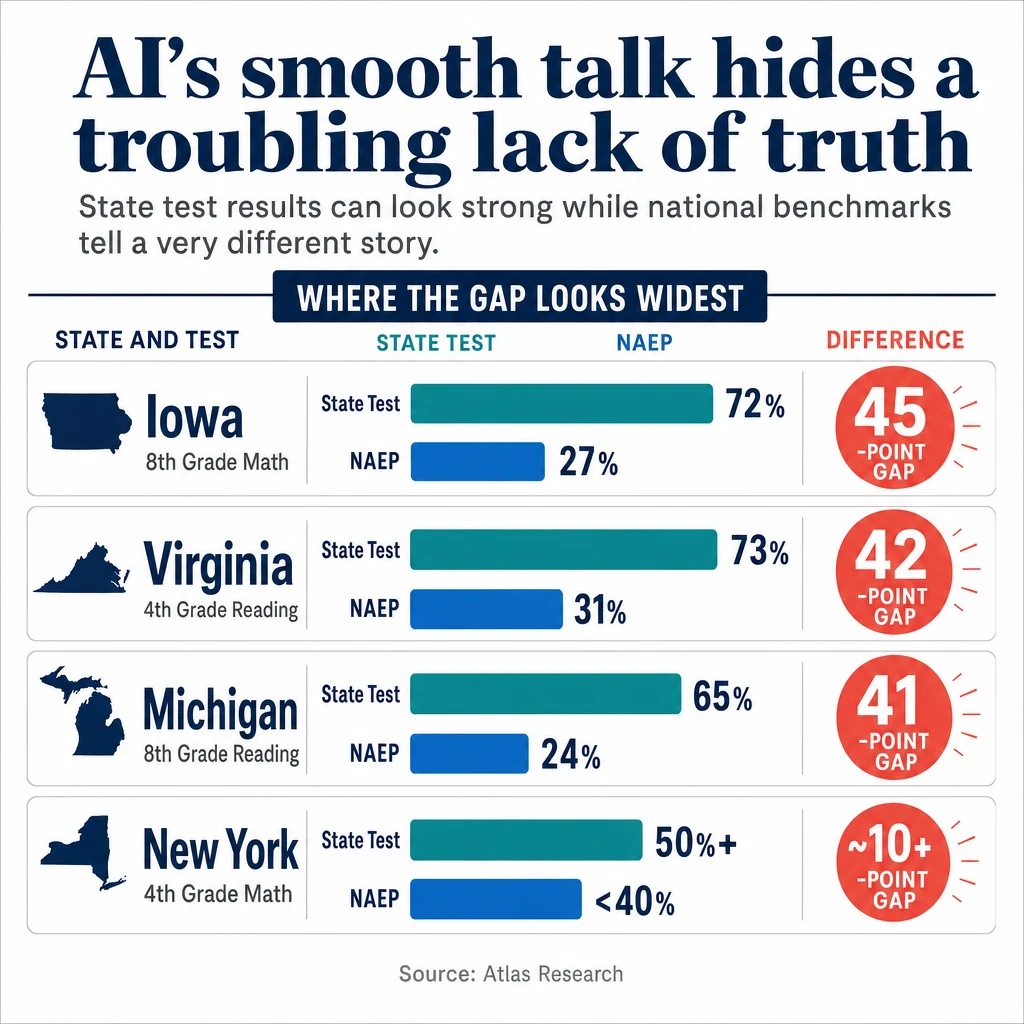
| State | Grade | Subject | State Test Proficiency | NAEP Proficiency | Gap (Percentage Points) |
|---|---|---|---|---|---|
| Iowa | 8th Grade | Math | 72% | 27% | 45 |
| Virginia | 4th Grade | Reading | 73% | 31% | 42 |
| Michigan | 8th Grade | Reading | 65% | 24% | 41 |
| New York | 4th Grade | Math | 50%+ | <40% | ~10+ |
"If we believe that NAEP is indeed the Nation's Report Record on student proficiency, then we would hope there is little difference between the outcomes on the two tests," said Jim Cowen, Executive Director of The Collaborative for Student Success. "But that's not the case. In many states, the gaps suggest that parents simply aren't getting the full picture of how prepared their kids are for college or the workforce."
The education case demonstrates what happens when measurement standards drift: the gap between reported and real performance grows, decision-makers lose accurate information, and the people most affected students, parents, future employers are systematically misled. The same dynamics apply to AI output: when linguistic confidence substitutes for factual verification, the people using the outputs cannot make accurate decisions.
Can AI be trained to be completely honest?
The honest answer is: not completely, but meaningfully narrower gaps are achievable. Complete honesty in AI would require complete verification which is computationally and epistemologically challenging for any system operating in domains with evolving, ambiguous, or contested knowledge. The goal is not perfection; it is the systematic reduction of the gap between what a system says and what it can verify.
The GenXis Research paper proposes a framework for this reduction built around mathematical grounding. The key elements include mathematical constraint, source custody, deterministic checks, calibrated abstention, and evidence memory.
Mathematical constraint involves embedding formal verification layers that can check AI outputs against structured knowledge representations ontologies, knowledge graphs, formal logic systems rather than relying solely on pattern matching against training data.
Source custody requires that factual claims be traceable to specific sources that can be independently verified. When an AI system produces a claim about a legal precedent, it should be able to point to the specific document it derived that claim from. This is different from training a system to produce plausible citations; it requires architectural support for citation verification.
Deterministic checks are formal verification procedures that can confirm or deny specific claims with certainty, rather than probability estimates. A deterministic check might query a database, run a calculation, or verify a logical derivation operations where the same input always produces the same verified output.
Calibrated abstention is perhaps the most counterintuitive element: a system that knows when it does not know, and communicates that uncertainty rather than producing a confident but ungrounded response. Human experts regularly say "I don't know" or "I'm uncertain about that." AI systems have historically been optimized to produce answers rather than to accurately characterize their uncertainty.
Evidence memory involves maintaining a traceable record of the evidence supporting each factual claim, allowing downstream users to verify the grounding independently. This is related to source custody but broader it encompasses the entire epistemic infrastructure supporting a claim.
How organizations can bridge the AI honesty gap
For organizations deploying AI in knowledge-work contexts, bridging the honesty gap requires operational changes alongside technical ones. The goal is to create verification cultures that treat AI outputs as drafts requiring grounding, not finished products requiring polishing.
The education sector's response to its honesty gap offers instructive lessons. According to the Fordham Institute's February 2025 commentary on the honesty gap, the challenge ahead is clear: "How can we reconcile the need for transparency and rigor with the public's skepticism toward the very systems meant to ensure both?" This question applies equally to AI deployment. Organizations need verification infrastructure that is rigorous enough to catch errors without creating skepticism about AI utility.
Several organizational practices have shown promise in narrowing AI honesty gaps:
- Source-grounded workflows: Require AI outputs to cite specific sources that can be verified before the outputs are used in decision-making. This shifts the verification burden from post-hoc checking to real-time grounding.
- Confidence calibration: Train teams to interpret AI confidence scores appropriately not as accuracy guarantees, but as uncertainty signals requiring verification. Systems that can accurately characterize their own uncertainty are more useful than systems that produce confident errors.
- Verification checkpoints: Build formal verification stages into workflows that use AI-generated content. This might include fact-checking protocols, source verification steps, or structured review processes that specifically address grounding rather than style.
- Calibrated deployment: Match AI system capabilities to use cases based on verifiable accuracy rates. High-stakes applications require stricter verification; lower-stakes applications can tolerate wider honesty gaps.
- Evidence documentation: Require that AI-assisted decisions document the evidence trail supporting factual claims. This creates accountability and enables post-hoc verification.
Massachusetts and Rhode Island offer a model in the education context. According to the Collaborative for Student Success analysis, these states closed their honesty gaps to within 5 percentage points or less across both grades and subjects. They did this through explicit commitment to high standards and transparent measurement. Organizations deploying AI can pursue analogous strategies: explicit commitments to verification standards, transparent reporting of AI limitations, and systematic measurement of accuracy rates.
What this means for GenXis Research readers
The honesty gap in AI is not a problem that will be solved by better training data alone, by larger models, or by more impressive fluency. It is a structural problem requiring structural solutions. The framework proposed by Ledyard and Tyler mathematical constraint, source custody, deterministic checks, calibrated abstention, and evidence memory offers a rigorous starting point for thinking about what verification infrastructure must look like.
For readers researching AI deployment, the practical questions are not abstract. They are operational: What verification protocols does your organization have in place? How do you distinguish between confident AI outputs and grounded AI outputs? Do your teams have the training to interpret AI uncertainty appropriately? Are your AI-assisted decisions documented with traceable evidence?
The education sector's parallel honesty gap demonstrates that measurement standards drift, that lowered bars create misleading signals, and that the people most affected students in one case, decision-makers in another lose when the gap between reported and real performance grows too wide. The antidote in both cases is the same: rigorous, verifiable, source-grounded standards and the organizational will to enforce them.
The compounding cost of linguistic confidence
There is a temporal dimension to the honesty gap that deserves explicit attention. When AI outputs with unverified factual claims enter organizational knowledge bases, they create what researchers call "citogenesis" risks the possibility that AI-generated content will be cited by other AI systems, by humans who trust it, and by downstream systems that use those citations as evidence. Each citation compounds the original error.
According to Cory Koedel of the University of Missouri-Columbia, writing in The Show-Me Institute's analysis of the honesty gap in education, "the education system often fails to communicate honestly with students, parents, and community members about how much students are actually learning." Koedel notes that the discrepancy between actual student performance and what is reported has "grown tremendously since the pandemic," with grades rising while test scores fall. The same dynamic applies to AI-generated knowledge: outputs compound, citations accumulate, and the gap between organizational knowledge and verified fact grows.
The compounding risk is not hypothetical. Organizations that deployed AI aggressively in 2023 and 2024 without robust verification infrastructure may have accumulated significant knowledge-base contamination. Content that entered workflows as "AI-assisted" may now be treated as established organizational knowledge without anyone tracing it back to its AI-generated origins.
The path forward requires both technical and cultural change. Technically, organizations need AI systems with verification infrastructure source custody, deterministic checks, calibrated abstention. Culturally, organizations need to treat AI fluency as a starting point for verification rather than an endpoint of trust.
Where to read further
For readers wanting to explore the honesty gap framework in depth, the primary source is GenXis Research's "The Honesty Gap: Words Vs. Math", which develops the formal definition of the honesty gap and the mathematical grounding framework for addressing it. The education sector analysis from the U.S. Chamber of Commerce Foundation provides concrete state-by-state data illustrating how the honesty gap manifests in measurable performance disparities. The Collaborative for Student Success's 2026 Honesty Gap analysis offers the most current comparative data across states, including the states that have made progress in narrowing their gaps.
For practitioners interested in the organizational dimensions, the Fordham Institute's commentary on education accountability offers transferable lessons about transparency, rigor, and the challenge of maintaining standards in contexts where lowered bars create short-term comfort at the cost of long-term accuracy.